
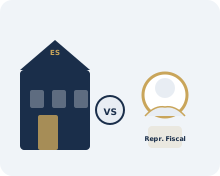
What is a permanent establishment?
A permanent establishment (PE) is a key concept in international tax law that designates a sufficiently substantial professional presence of a foreign company in France to justify its liability to French tax on profits. It is not a separate legal entity, but a tax nexus created by certain forms of presence.
Under French domestic law (Article 209 of the French General Tax Code (CGI)) and tax treaties (OECD Model, Article 5), a permanent establishment can take several forms:
- Fixed place of business: office, workshop, factory, shop, mine — any premises where the activity is carried on durably and permanently.
- Building site or construction or installation project: if its duration exceeds 12 months (or 6 months depending on the applicable treaty).
- Dependent agent: an individual or legal entity that habitually acts in France on behalf of the foreign company and has the authority to conclude contracts in its name.
The tax representative: a purely administrative tool
The accredited tax representative is a very different institution. They are appointed by a foreign company not established in the EU to fulfil its French VAT obligations on its behalf and, for property sales, the obligations related to withholding tax on capital gains.
Their role is strictly administrative and declaratory. They:
- Receive and sign VAT returns (CA3) on behalf of their client
- Are jointly and severally liable for the payment of VAT due
- Act as the point of contact with the DGFiP for VAT matters
- Have no commercial authority: they sell nothing, conclude no contracts
Appointing a tax representative does not create a permanent establishment and does not give rise to French corporate income tax liability. It is an administrative obligation that allows the company to fulfil its VAT obligations without creating a lasting tax presence.
Comparison table: PE vs tax representative
| Criterion | Permanent establishment | Accredited tax representative |
|---|---|---|
| Legal nature | Permanent tax presence of the company | Third-party agent accredited by the DGFiP |
| Corporate income tax | Yes — IS on attributable profits | No |
| VAT | Yes — VAT-registered | Yes — manages VAT returns |
| Accounting obligations | Annual tax return mandatory | No separate accounting |
| Joint liability | Not applicable | Yes — jointly liable for VAT payment |
| Choice / obligation | Legal qualification (may be involuntary) | Voluntary or mandatory appointment (non-EU) |
Which structure for which situation?
The choice between creating a permanent establishment (branch, subsidiary) and simply appointing a tax representative depends on the nature and extent of your activity in France.
As a general rule: if you simply want to fulfil your VAT obligations without creating a lasting tax presence, a tax representative is the right solution. If your activity involves a substantial commercial presence, the question of a permanent establishment must be analysed with specialist counsel.
For your VAT obligations, consult our list of accredited tax representatives and identify the professional suited to your situation.