
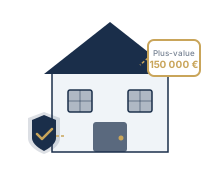
Why is a tax representative necessary for real estate?
When a non-resident sells property located in France and realises a capital gain, the French State needs a local point of contact to ensure payment of the corresponding tax. This is the role of the accredited tax representative: they calculate the taxable capital gain, prepare the tax return, collect the tax from the sale price and remit it to the French tax administration.
Without a tax representative, the notary is legally required to withhold part of the sale proceeds to cover the estimated tax. This withholding mechanism protects the State against the risk of tax evasion by taxpayers with no fiscal ties in France. The tax representative removes this block by taking charge of the return and payment within the regulatory deadlines.
Who is subject to the real estate tax representative obligation?
The obligation to appoint an accredited tax representative for a property sale applies to the following categories:
- Non-resident individuals whose gross capital gain on the sale exceeds €150,000, regardless of nationality (except EEA nationals under certain conditions)
- Non-resident legal entities (foreign companies, foreign SCIs, offshore holding companies) that sell French real estate, with no threshold requirement
- Non-residents receiving rental income in France where that income triggers a VAT obligation (professional furnished letting, commercial property)
- Estates and inheritances involving the sale of French real estate by non-resident heirs
By contrast, nationals of the European Economic Area (EU + Iceland, Liechtenstein, Norway) benefit from an exemption from the accredited tax representative requirement through mutual assistance mechanisms between member states, provided their country is effectively bound to France by a mutual recovery assistance convention.
Taxation on a property sale for non-residents
The taxation of a property sale by a non-resident involves several layers of tax. The net taxable capital gain is calculated by deducting from the sale price the acquisition price, acquisition costs, renovation works carried out, and ownership-period allowances. A 6% annual allowance applies from the 6th to the 21st year of ownership, then 4% for the 22nd year, leading to full income tax exemption after 22 years.
On the net capital gain thus calculated, two cumulative taxes apply:
- Income tax: rate of 19% for EEA residents, 26.5% for residents of other countries (subject to applicable tax treaties)
- Social levies: 18.6% since 1 January 2026 (17.2% until 31 December 2025) levied on non-residents affiliated to a social security scheme outside the EEA, Switzerland or the United Kingdom. Non-residents affiliated to a social security scheme in the EU, the EEA (Iceland, Norway, Liechtenstein), Switzerland or the United Kingdom are exempt from CSG and CRDS and pay only the 7.5% solidarity levy (unchanged in 2026)
- Surcharge: from 2% to 6% for net capital gains exceeding €50,000
The tax representative files the return on form 2048-IMM, calculates the total tax and makes the payment at the time of the notarial deed. This must therefore be prepared before the final signing with the notary.
Guides in this section
Find below all guides on real estate fiscal representation in France for non-residents.
Selling property in France
Complete guide to selling real estate in France as a non-resident.
Read the guideReal estate capital gains
Calculation, rates and the role of the accredited tax representative on capital gains.
Read the guide€150,000 threshold
What crossing the €150,000 threshold means for your legal obligation.
Read the guideSocial levies
The 18.6% social levies (since 2026) on real estate income of non-residents.
Read the guideRental income
Tax obligations on rental income received in France by a non-resident.
Read the guideSCI and foreign companies
Mandatory fiscal representation for a foreign SCI or company owning property in France.
Read the guideRole of the notary
How the notary and tax representative work together during a property sale.
Read the guidePossible exemptions
Cases of capital gains exemption for non-residents.
Read the guideSuccession and inheritance
Tax obligations when inheriting or receiving a bequest of real estate in France.
Read the guideLMNP for non-residents
Furnished rental (LMNP) and fiscal representation for expatriates.
Read the guideAirbnb and short-term rentals
Tax obligations for non-residents on short-term rentals in France.
Read the guide