
Taxation of a real estate sale for a non-resident
When a non-resident sells real estate in France (apartment, house, land, commercial premises), they are subject to French tax on the capital gain realised. The capital gain is calculated as the difference between the sale price and the acquisition price, adjusted for acquisition costs and deductible works.
The applicable tax rate depends on the seller's situation:
- Residents of the EU or EEA (Iceland, Norway, Liechtenstein): 19% on the net capital gain + 7.5% social contributions (under conditions relating to their country of residence's social security system).
- Residents outside the EU/EEA (USA, Canada, Australia, Dubai, Morocco, China...): 19% + 18.6% social contributions since 1 January 2026 (subject to confirmation by the French tax authorities) (17.2% until 31 December 2025). Progressive allowances for length of ownership apply in both cases.
Progressive allowances reduce the taxable capital gain based on the length of ownership: beyond 22 years of ownership, the capital gain is fully exempt from income tax; beyond 30 years, it is exempt from social contributions.
When is the accredited tax representative mandatory?
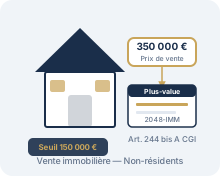
The obligation to appoint a specific accredited tax representative for real estate capital gains is triggered as soon as the net taxable capital gain exceeds €150,000. This threshold is assessed before applying length-of-ownership allowances.
In this case, the notary is required to block the payment of the sale proceeds until the non-resident seller appoints an accredited tax representative. This blocking can last several weeks if the appointment is not anticipated, with potential contractual consequences.
Exempt from this obligation are:
- Sellers residing in an EU or EEA country
- Sellers whose net capital gain is less than €150,000
- Sellers benefiting from full exemption (length of ownership, principal residence under conditions)
Steps in the sale: the role of each party
The sale of real estate by a non-resident involves several parties whose roles are complementary and sometimes conditional on one another.
- The estate agent: finds the buyer, negotiates the price, drafts the preliminary sale agreement. They should be informed from the outset of the seller's non-resident status to anticipate the tax procedures.
- The notary: draws up the authenticated deed, calculates the taxable capital gain, makes the withholding tax deduction. They verify the presence of the accredited tax representative if the capital gain exceeds €150,000. Without this verification, the deed cannot be signed.
- The accredited tax representative: appointed before signing the authenticated deed, they validate the capital gain calculation, sign the 2048-IMM declaration, and assume liability before the DGFiP. Their fees are generally deducted from the sale proceeds retained.
- The tax authorities (DGFiP): may question the notary or tax representative about the capital gain calculation. They retain a right of review for 3 years from the date of sale.
Key watch points and common mistakes
Non-residents selling their property in France regularly make several avoidable mistakes:
- Not planning the appointment of the tax representative in advance: finding an accredited professional takes time. If you start looking after signing the preliminary sale agreement, it can delay the sale by several weeks and create tensions with the buyer.
- Forgetting to keep records of works carried out: improvement works carried out by the seller (not the tenant) are deductible from the capital gain calculation. Without invoices, they cannot be taken into account.
- Confusing the sale price with the capital gain: the tax representative obligation applies to the capital gain, not the sale price. A property sold for €500,000 but purchased for €400,000 generates a gross capital gain of €100,000 — below the mandatory threshold.
- Not informing the notary of your tax residence: the notary is required to verify the seller's tax residence to apply the correct regime.
To find an accredited tax representative specialising in non-resident real estate capital gains, consult our list of DGFiP-accredited tax representatives. Several firms there are presented with their expertise in non-resident real estate.