Social Levies on Real Estate Income for Non-Residents in France
CSG, CRDS, solidarity levy: non-resident property owners in France are subject to social levies on their real estate income. Here is what you need to know to avoid unpleasant surprises.
Principle of social levies for non-residents
Social levies are a set of contributions funding the French social protection system: CSG (generalised social contribution), CRDS (contribution to the repayment of the social debt) and various additional levies. For a long time, non-residents were exempt from CSG and CRDS when they were not affiliated with the French social security system.
Since the Finance Act for 2019 — and the European case law that forced France to adapt — the regime has been clarified. All non-residents are now subject to social levies on their French-source real estate income. The nature and rate of these levies vary depending on the taxpayer's country of residence.
2026 update
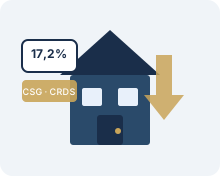
The regime resulting from Act 2018-1317 has been consolidated. EEA non-residents affiliated with the social security system of their country of residence benefit from the reduced solidarity levy (7.5%, unchanged) rather than full social levies (18.6% from 1 January 2026, up from 17.2% as the CSG rises from 9.2% to 10.6%) (subject to confirmation by the French tax authorities).
Applicable rates depending on your situation
The effective rate depends on your country of residence and your affiliation with a social security scheme:
Non-resident situation
Applicable levies
Overall rate
Outside EU / EEA / Switzerland
Full social levies (CSG + CRDS + others)
18.6% (since 1 January 2026; 17.2% until 31 December 2025)
EU / EEA / Switzerland, affiliated with a foreign scheme
Solidarity levy only
7.5%
Not affiliated with any scheme (outside EEA)
Full social levies
18.6% (since 1 January 2026; 17.2% until 31 December 2025)
For residents of non-EEA countries that have a tax treaty with France containing a specific clause on social levies, a reduction may apply. It is advisable to check the bilateral treaty applicable to your situation.
Income covered and calculation of the tax base
Social levies apply to two categories of French-source real estate income:
Property income: rent received from unfurnished (property income) or furnished (BIC) properties located in France. The tax base is the net income after deduction of expenses (works, loan interest, management fees).
Real estate capital gains: gain realised on the sale of a property in France. The tax base is the net capital gain after allowances for the holding period.
Calculation example — capital gain
A US national sells an apartment in Paris with a net capital gain of €100,000. They will pay: €26,500 in income tax (26.5% rate applicable outside the EU/EEA) + €18,600 in social levies (18.6% since 1 January 2026; €17,200 at the 17.2% rate until 31 December 2025) = €45,100 in total, collected by the accredited tax representative at the time of signing the notarial deed.
Role of the tax representative for social levies
When the real estate capital gain exceeds €150,000, the presence of an accredited tax representative is mandatory. This representative calculates and remits the social levies at the same time as the capital gains tax, directly to the French Treasury, at the time of signing before the notary.
For rental income, the tax representative can be mandated to file the annual property income tax return (form 2044) and pay the corresponding social levies. This service is particularly useful for non-residents who are geographically distant or unfamiliar with the French tax system.
To find a qualified professional, consult our list of DGFiP-accredited tax representatives. These experts are well-versed in the calculation of social levies and will help you avoid liquidation errors.
Beware of rate errors
Applying the rate of 18.6% (since 1 January 2026; 17.2% until 31 December 2025) instead of 7.5% (or vice versa) constitutes a tax liquidation error. In the event of an overpayment, a refund can be requested from the tax authorities, but the procedure is lengthy. In the event of an underpayment, penalties apply.
Frequently asked questions
Yes. Since 2019, all non-residents must pay social levies on their French-source real estate income (rental income and capital gains), regardless of whether they are affiliated with a social security scheme in the EU. The overall rate is 18.6% from 1 January 2026 (17.2% until 31 December 2025), as the CSG rises from 9.2% to 10.6%. However, EEA nationals covered by another Member State's social security scheme do not pay CSG and CRDS but instead pay a solidarity levy of 7.5% (unchanged).
The overall social levy rate is 18.6% for residents outside the EEA from 1 January 2026 (17.2% until 31 December 2025), following the increase of the CSG from 9.2% to 10.6%. For non-residents who are nationals of EEA countries (EU, Norway, Iceland, Liechtenstein) or Switzerland and are affiliated with a foreign social security scheme, the reduced solidarity levy of 7.5% applies (unchanged).
Yes. Capital gains realised by a non-resident on the sale of a property in France are subject to income tax (19% for EU/EEA residents, 26.5% or 36.2% outside the EU/EEA) and social levies (18.6% from 1 January 2026, previously 17.2%, or 7.5% depending on the situation). The accredited tax representative is responsible for remitting these amounts at the time of the transaction.
No. Non-residents cannot deduct CSG from their taxable income in France, unlike French tax residents who benefit from partial deductibility. This is an unfavourable feature of the non-resident tax regime.
Browse our list of tax representatives accredited by the French Tax Authority (DGFiP). Compare specialities, get a quote and secure your tax obligations in France.