
The legal framework for non-resident tax obligations in France
France imposes a set of tax obligations on non-residents — whether individuals or companies — as soon as they carry out certain transactions on its territory. These obligations rest primarily on two pillars: the French General Tax Code (Code général des impôts — CGI), notably Articles 244 bis A (real estate capital gains) and 289 A (VAT tax representative), and the bilateral tax treaties signed between France and numerous countries.
The central compliance mechanism for non-residents is the appointment of a DGFiP-accredited tax representative. This representative acts as the legal point of contact with the French administration and is jointly and severally liable for the tax obligations of their principal. In their absence, the non-resident taxpayer is directly exposed, with no intermediary to defend them or organise their compliance.
Who is subject to tax obligations in France?
French tax obligations apply to a wide range of profiles:
- Non-EU companies carrying out sales, services or imports in France — VAT tax representative obligation (Art. 289 A CGI)
- All non-residents (EU and non-EU) selling property in France above €150,000 — accredited tax representative obligation for calculation and payment of capital gains tax
- French expatriates receiving income from French sources (rent, dividends, French-source salaries) — declarative obligation and, in some cases, withholding tax
- Foreign companies with a permanent establishment in France — subject to corporate income tax on their French results
- Non-resident holding companies and structures owning real estate in France — subject to the annual 3% tax and various declarative obligations
Ignorance of the law is not an accepted excuse before the French tax administration. The principle of territorial taxation applies in full: as soon as a transaction is carried out on French soil or generates income from a French source, French tax obligations apply, regardless of the taxpayer's country of residence.
Penalties and consequences for non-compliance
Failure to meet French tax obligations by non-residents can lead to considerable financial consequences. The tax administration has increasingly effective detection tools: automatic exchange of information between countries (OECD CRS standard), data transmitted by digital marketplaces, notarial deeds, customs declarations, and VAT refund applications.
The main applicable penalties are:
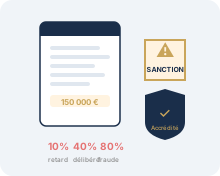
- 10% surcharge for late payment or late filing of a return (without deliberate intent)
- 40% surcharge for deliberate failure (where the administration proves the taxpayer was aware of their obligations)
- 80% surcharge for fraudulent manoeuvres or abuse of rights
- Late-payment interest at a rate of 0.20% per month (2.40% per year) on amounts owed
- Ex officio assessment: if no return has been filed, the administration reconstructs the taxable base unilaterally, often unfavourably for the taxpayer
- Criminal prosecution for tax fraud in the most serious cases, with sentences of up to 7 years' imprisonment and a €3 million fine
Guides in this section
Find below all guides on obligations, penalties and alternatives for non-residents in France.
Penalties and surcharges
Penalties, fines, late-payment interest: the precise consequences of not having a tax representative in France.
Read the guideTax audit in France
How does a tax audit work for a non-resident? Procedure, rights and deadlines.
Read the guideThe 10 mistakes to avoid
The most common tax pitfalls for non-residents in France and how to avoid them.
Read the guideTax regularisation
How to regularise your tax situation in France as a non-resident? Where to start?
Read the guideAlternatives to the tax representative
Are there legal solutions to avoid the tax representative in France? An honest assessment.
Read the guidePermanent establishment
Subsidiary, branch, permanent establishment in France: differences from fiscal representation.
Read the guideStatute of limitations
Audit and recovery deadlines of the French tax administration for non-residents.
Read the guideIncome tax
How is income from French sources received by a non-resident taxed?
Read the guideCorporate tax for foreign companies
Corporate income tax in France for foreign companies with activities on French territory.
Read the guide