
Who is subject to non-resident income tax?
In France, tax residence is the key criterion for determining the extent of tax liability. A person is considered a non-resident for tax purposes in France if they do not have their principal home or usual place of stay there, nor their main economic interests, and do not carry on their principal professional activity in France (Article 4 B of the French General Tax Code (CGI)).
Non-residents are subject to a limited tax liability: they are only taxable in France on their French-source income. By contrast, French tax residents are taxed on their worldwide income.
Those subject to non-resident income tax include:
- French expatriates living abroad who receive French-source income
- Foreigners living outside France who own property in France
- Foreign nationals who carried out salaried activity in France before leaving
- Cross-border workers, depending on the applicable tax treaty
Which income is taxable in France?
For a non-resident, taxation in France applies only to income whose source is located in France. The main categories are as follows.
| Income category | Examples | Taxation method |
|---|---|---|
| Rental income (revenus fonciers) | Rent from apartments, houses, commercial premises located in France | Progressive scale or micro-foncier regime; withholding tax possible |
| Capital gains on property | Sale of property located in France | 19% + social levies; withholding by the notary |
| Salary income | Wages paid for activity physically carried out in France | Withholding tax (Art. 182 A CGI); progressive scale |
| Pensions and retirement | French pensions (social security, supplementary schemes) | Final withholding tax or progressive scale depending on treaty |
| Investment income | Dividends from French companies, interest from French accounts | Withholding tax (12.8% in general, variable depending on treaty) |
Tax rates and return filing
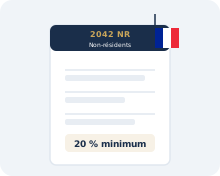
French-source income of non-residents is in principle subject to a minimum tax rate, unless otherwise provided by treaty.
- Rate of 20% for the portion of income not exceeding the upper limit of the 2nd tax bracket on the progressive scale
- Rate of 30% for the portion of income exceeding that limit
The taxpayer may opt for the application of the average rate (the rate that would apply if all their worldwide income were taxed in France) if they can show that this rate is lower than the 20% or 30% minimum. This option, known as the "Quémener option", is particularly advantageous for individuals with modest worldwide income.
The income tax return must be filed each year using form 2042 NR, together with specific forms depending on the nature of the income (2044 for rental income, 2048-IMM for capital gains on property). The Non-Residents Tax Centre (CINR) in Noisy-le-Grand centralises the processing of these returns.
Withholding tax and social levies
For many income categories, tax is collected at source before the taxpayer even receives their income. This mechanism simplifies collection and ensures that the French State receives payment of tax even from taxpayers domiciled abroad.
Withholding tax on wages (Art. 182 A CGI): the employer or paying party deducts tax before paying the wage. The rate is calculated according to a specific non-resident scale. This withholding is generally a final settlement, except for high remuneration.
Withholding on capital gains on property: when a non-resident sells property, the notary deducts the capital gains tax directly from the sale price. It is for this transaction that the accredited tax representative is required where the net capital gain exceeds €150,000.
Social levies: in addition to income tax, French-source investment income (rental income, capital gains on property) is subject to social levies. The rate varies between 7.5% and 18.6% since 1 January 2026 (17.2% until 31 December 2025) (subject to confirmation by the French tax authorities) depending on whether the non-resident is affiliated to a social security scheme in the EEA, Switzerland or the United Kingdom (only the 7.5% solidarity levy applies in that case) or not.
To navigate these obligations and avoid filing errors, non-residents can rely on an accredited tax representative who specialises in the French non-resident tax regime.