
Calculating the taxable capital gain
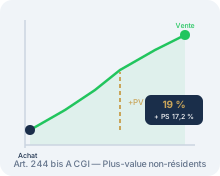
The real estate capital gain is the difference between the sale price and the acquisition price, both adjusted for certain costs. This calculation is carried out by the notary in coordination with the accredited tax representative, before signing the authenticated deed of sale.
The sale price used is in principle the price stated in the deed of sale, reduced by costs borne by the seller (estate agent fees, technical surveys, etc.). The acquisition price includes the original purchase price, plus actual acquisition costs (or a flat-rate allowance of 7.5%) and actual works expenditure (or a flat-rate allowance of 15% if the property has been held for more than 5 years).
- Acquisition costs: notarial fees, registration duties, agency fees borne by the buyer at the time of acquisition.
- Deductible works: construction, reconstruction, extension, improvement — excluding maintenance works and rental expenses. Supporting documents are mandatory.
Tax rates and length-of-ownership allowances
The net capital gain is then subject to two separate levies, to which progressive allowances apply based on the length of ownership of the property.
The social contributions rate depends on the seller's social security affiliation. Non-residents affiliated to a third-country scheme (United States, Canada, Australia, Monaco, Singapore, the Gulf states, etc.) are liable for the full social contributions: 18.6% since 1 January 2026 (17.2% until 31 December 2025), following the increase of the CSG from 9.2% to 10.6%. By contrast, sellers affiliated to a social security scheme in the EU, the EEA (Iceland, Norway, Liechtenstein), Switzerland or the United Kingdom are exempt from CSG and CRDS and pay only the 7.5% solidarity levy (unchanged in 2026). Despite Brexit, UK residents affiliated to British social security remain exempt from CSG/CRDS and pay only 7.5%, under the EU-UK withdrawal agreements (BOFiP BOI-RFPI-PVINR-20-20).
| Length of ownership | Income tax allowance (19%) | Social contributions allowance (18.6% since 1 January 2026, 17.2% until 31 December 2025) (subject to confirmation by the French tax authorities) |
|---|---|---|
| Less than 6 years | 0% | 0% |
| 6 to 21 years | 6% per year | 1.65% per year |
| 22nd year | 4% (income tax exemption) | 1.6% |
| 23 to 30 years | Exempt from income tax | 9% per year |
| Beyond 30 years | Exempt from income tax | Exempt from social contributions |
For net capital gains exceeding €50,000, a progressive surcharge is added to the 19% rate: from 2% (between €50,001 and €100,000) to 6% (beyond €260,000). This surcharge applies regardless of the length of ownership.
Role of the accredited tax representative in capital gains
For non-residents outside the EU/EEA whose net taxable capital gain exceeds €150,000, the appointment of an accredited tax representative specifically approved for real estate capital gains is mandatory. This professional plays a precise and irreplaceable role:
- Verifying the capital gain calculation: the representative reviews the notary's calculation, ensures that all deductible costs are taken into account, and that allowances are correctly applied.
- Signing the 2048-IMM return: they sign the return in place of the non-resident seller, assuming joint and several liability before the DGFiP.
- Paying the tax: they ensure that the withholding tax made by the notary exactly corresponds to the tax owed and remits it to the tax authorities.
- Post-sale follow-up: in the event of a request from the administration (audit, request for supporting documents), they remain the appointed point of contact until the file is closed.
The 2048-IMM return: procedure and timelines
The 2048-IMM return (for built properties) or 2048-M (for building plots) must be filed on the day of signing the authenticated deed of sale at the notary's office. It is the notary who physically submits the return together with the withholding tax payment to their relevant tax office.
The procedure is as follows:
- Before signing: the tax representative receives the file documents (prepared deed of sale, capital gain calculation), reviews them, and co-signs the return.
- On the day: the notary files the 2048-IMM and pays the withholding tax to the tax treasury. The balance of the sale proceeds is released to the seller.
- After the sale: in the event of a refund of overpaid tax (if the final calculation is more favourable), the tax representative submits a claim for restitution to the DGFiP.
To find an accredited tax representative specialising in real estate capital gains for non-residents, consult our list of DGFiP-accredited tax representatives.