
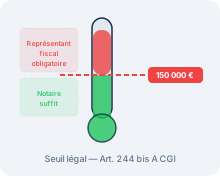
How does the €150,000 threshold work?
The €150,000 threshold mechanism is set out in Article 244 bis A of the French General Tax Code. It provides that when a non-resident established outside the European Union (or outside the EEA) realises a real estate capital gain exceeding this amount, it is mandatory for a DGFiP-accredited tax representative to act as guarantor for the tax owed.
This threshold is assessed on the net capital gain before applying length-of-ownership allowances. In other words, even if the length of ownership significantly reduces the tax effectively owed, the tax representative obligation applies as soon as the calculated gross capital gain exceeds €150,000.
Practical consequences for the real estate sale
Exceeding the threshold has immediate and concrete consequences on the progress of the transaction:
- Sale proceeds blocked by the notary: if the threshold is exceeded and no accredited tax representative has been appointed, the notary is legally required not to pay the sale proceeds to the seller. The proceeds remain blocked until the situation is regularised.
- Conditional signing: in certain cases, the notary may refuse to sign the deed of sale until the accredited tax representative has accepted the mandate and validated the capital gain calculation.
- Joint and several liability of the representative: the accredited tax representative assumes joint and several liability for the tax owed. That is why they carefully review the file before accepting the mandate.
- 2048-IMM return co-signed: the capital gain declaration is co-signed by the tax representative and the notary, then submitted to the tax office at the time of the sale.
How to know whether you exceed the €150,000 threshold
A simple preliminary calculation allows you to estimate whether your sale exceeds the threshold:
- Step 1 — Estimate your sale price: expected net sale price (after agent fees).
- Step 2 — Calculate your adjusted acquisition price: original purchase price + acquisition costs (actual or 7.5% flat rate) + works (actual or 15% flat rate if held for more than 5 years).
- Step 3 — Calculate the gross capital gain: Sale price − Adjusted acquisition price.
- Step 4 — Compare with €150,000: if the gross capital gain exceeds this amount, the obligation applies.
Planning ahead: the key to a smooth sale
The main mistake non-residents make is not planning ahead on the tax representative question. Appointing an accredited professional takes time:
- Finding a representative who is available and specialises in non-resident real estate
- Providing them with the file documents (acquisition deeds, works receipts, title deed)
- Signing the representation mandate
- Waiting for their validation before signing at the notary
In practice, starting the search as soon as the property is listed for sale — rather than after signing the preliminary agreement — avoids any blockage. If the capital gain estimate is close to the €150,000 threshold, it is prudent to appoint a representative as a precaution. Their cost is negligible compared to the risk of a transaction being blocked.
To plan ahead and find an accredited real estate tax representative without delay, consult our list of DGFiP-accredited tax representatives now.