
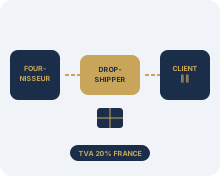
Dropshipping and French VAT
Dropshipping involves selling products without storing them yourself: the supplier ships directly from their warehouse to the end customer. This logistics model has no effect on tax obligations. What matters for French VAT is the place of delivery (France) and the seller's status (established outside or within the EU).
If you are a dropshipper established outside the European Union and you sell to consumers in France, you must collect and remit French VAT on each sale. The standard rate is 20%, applicable to the vast majority of products sold online.
When does the tax representative obligation apply?
The obligation to designate an accredited tax representative (Article 289 A of the French General Tax Code) applies as soon as your business is established outside the European Union and carries out taxable operations in France. In practice, for a dropshipper:
- You are outside the EU (e.g. United States, post-Brexit UK, China, Australia…) → tax representative mandatory for your sales in France
- You are in the EU (e.g. Spain, Germany) → no VAT tax representative required, but OSS may apply if your B2C turnover exceeds €10,000 per year in the EU
- Parcels ≤ €150 shipped from outside the EU → IOSS is an alternative, but requires a fiscal intermediary if you are outside the EU
| Dropshipper situation | Obligation | Solution |
|---|---|---|
| Outside EU, B2C sales in France | 20% VAT + tax representative | VAT registration + accredited representative |
| Outside EU, parcels ≤ €150 | Import VAT + declaration | IOSS via non-EU fiscal intermediary |
| In EU, turnover > €10,000 | Destination country VAT | OSS (One-Stop Shop) |
| In EU, turnover ≤ €10,000 | Origin country VAT | Local declaration |
Compliance solutions depending on your situation
For a non-EU dropshipper, two main approaches allow you to comply with French VAT.
Solution 1 — Standard VAT registration with a tax representative. This is the reference solution for sellers with a significant volume of sales or parcels over €150. An accredited tax representative obtains your French VAT number and manages your CA3 returns. This solution covers all your operations without value limits.
Solution 2 — IOSS (Import One-Stop Shop) for small parcels. IOSS is a simplified scheme for imports of goods worth €150 or less. It allows VAT to be collected at the point of sale. If your business is outside the EU, you must go through a fiscal intermediary established in the EU to access IOSS. This option is ideal for dropshippers selling low-value items.
Risks in case of non-compliance
Non-compliant dropshippers face concrete risks that can quickly jeopardise their business:
- Parcels held at customs, with VAT and duties claimed from the recipient
- Suspension of VAT number or refusal of registration
- Penalties of 5% on undeclared VAT and late payment surcharges
- Joint fiscal liability of the marketplace (Amazon, Shopify may be implicated)
- Seller account closure on certain platforms
Using an accredited tax representative from the launch of your business in France allows you to avoid these obstacles and develop your dropshipping activity with peace of mind.