
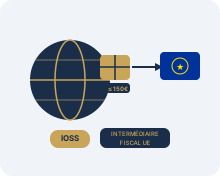
IOSS: principle and operation
IOSS (Import One-Stop Shop), which came into force on 1 July 2021, is a simplified VAT declaration and payment scheme for imports of low-value goods. It covers shipments whose intrinsic value does not exceed €150, sent from a third country to consumers in the European Union.
Before IOSS, parcels under €22 benefited from a VAT import exemption. This exemption was abolished in 2021. VAT is now due from the very first euro. IOSS allows the seller to collect this VAT directly at the time of the online transaction, at the rate applicable in the destination country. The customer therefore does not pay additional charges at delivery.
The IOSS fiscal intermediary for non-EU sellers
To register for IOSS, a business must in principle be established in the European Union or in a third country that has concluded an administrative cooperation agreement with the EU. Non-EU businesses that do not meet these conditions must mandatorily designate an IOSS fiscal intermediary.
This intermediary is a professional established in the EU who:
- Registers for IOSS in their name on your behalf
- Collects and declares monthly VAT on your eligible sales (≤ €150)
- Is jointly liable for the VAT due
- Assigns you an IOSS number to include on your shipments
The IOSS intermediary differs from the standard tax representative (Article 289 A of the French General Tax Code), but both roles are often performed by the same accredited professionals.
IOSS vs standard tax representative
These two schemes address different situations. Here are the criteria for choosing:
| Criterion | IOSS + intermediary | Standard tax representative |
|---|---|---|
| Parcel value | ≤ €150 only | All values |
| Shipping origin | Outside EU to EU | Any origin |
| Type of sales | B2C only | B2C and B2B |
| Local VAT number | Not required (global IOSS) | Yes, per EU country |
| Declaration frequency | Monthly (1 EU declaration) | Monthly or quarterly |
For many non-EU e-commerce merchants, both schemes are complementary: IOSS for small B2C parcels, and the standard tax representative for parcels > €150, B2B sales, or stock held in France.
Setting up IOSS for your store
The IOSS registration process involves the following steps for a non-EU seller:
Step 1 — Choose an IOSS intermediary in the EU. Your intermediary must be established in an EU member state and be able to manage monthly IOSS declarations. Some accredited tax representatives also offer this service.
Step 2 — Register on the IOSS portal. The intermediary submits the registration application to the tax portal of their member state. You receive a 12-digit IOSS number.
Step 3 — Configure your store. The IOSS number must be integrated into your shipping workflows (customs files, parcel labels) so that parcels are recognised as IOSS-eligible at the border.
Step 4 — Monthly declarations. Your intermediary files an IOSS declaration each month, detailing sales by EU member state, and remits the corresponding VAT.
Compare professionals offering both IOSS and standard tax representation: consult our list of accredited tax representatives.