
What is distance selling to France?
Distance selling refers to sales of goods to private individuals (B2C) where the seller arranges or organises transport from another country to France. This regime differs from B2B transactions where the reverse charge mechanism applies between businesses.
Since the VAT reform of July 2021 (EU Directive 2017/2455), the rules have changed fundamentally. The objective is simple: VAT must be collected in the country of the final consumer, not in the seller's country. This reform created the OSS (One-Stop Shop) and changed the obligations of foreign sellers.
The €10,000 OSS threshold: who is affected?
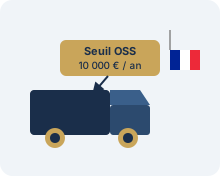
For businesses established in the European Union, a single threshold of €10,000 in annual sales to all EU consumers (all member states combined) has been established. Below this threshold, the seller can continue to apply the VAT of their country of establishment. Beyond it, they are liable for VAT in each destination country.
This system is simplified through the OSS: instead of registering in each European country, the business declares and pays all its intra-community VAT from its country of establishment. However, this considerable simplification only applies to EU businesses.
| Seller situation | Applicable threshold | Mechanism |
|---|---|---|
| Established in EU, sales < €10,000/year to EU | Origin country VAT | Local declaration |
| Established in EU, sales > €10,000/year to EU | Consumer country VAT | OSS (One-Stop Shop) |
| Established outside EU, all sales to France | No threshold | Tax representative mandatory |
Non-EU sellers: specific rules and tax representative
If your business is established outside the European Union — United States, China, post-Brexit UK, Canada, Australia — the rules are stricter. OSS is not available to you outside the IOSS scheme (limited to imports of parcels under €150). For any sale of goods stored in France or worth more than €150, you must mandatorily:
- Register for VAT in France with the Foreign Business Tax Office (SIEE)
- Designate a tax representative accredited by the French Tax Authority (DGFiP) under Article 289 A of the French General Tax Code (CGI)
- File periodic VAT declarations (CA3) through this representative
- Maintain accounting records of taxable operations in France
Practical obligations: registration and declarations
The VAT registration procedure for a non-EU seller follows a precise path. The tax representative compiles a file including the foreign company's articles of association, proof of its activity, and the power of attorney granted to the representative. Registration with the SIEE generally takes 4 to 6 weeks.
Once registered, the seller receives a French intra-community VAT number (FR + 11 digits). This number must appear on all invoices issued for taxable operations in France. VAT returns (form CA3) are filed monthly or quarterly depending on the scheme.
To manage your distance selling obligations in France smoothly, the safest solution is to appoint an accredited DGFiP tax representative. Our list allows you to compare professionals by their e-commerce expertise.