
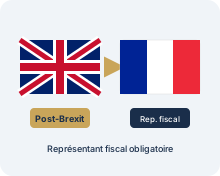
The impact of Brexit on your French tax obligations
On 31 December 2020, the United Kingdom officially left the European single market. From a tax perspective, the consequences were immediate: the UK became a third country to the European Union, on the same footing as the United States, China or Canada. This change in status upended the obligations of British businesses and residents with activities or assets in France.
Before Brexit, a UK company did not need to appoint an accredited fiscal representative to register for VAT in France: it could deal directly with the Service des Impôts des Entreprises Étrangères. Since 1 January 2026, that route is closed to it. The fiscal representation obligation set out in Article 289 A of the French General Tax Code (CGI) now applies in full.
UK businesses: new VAT obligations in France
Any UK company (Ltd, LLP, PLC…) carrying out VAT-liable transactions in France must now:
- Appoint a fiscal representative accredited by the French Tax Authority (DGFiP) before any taxable transaction
- Register for VAT in France through that representative
- File periodic VAT returns (CA3)
- Arrange or have arranged a bank guarantee if required by the tax authority
The most affected sectors are e-commerce (sale of goods stored or dispatched to France), B2C service provision, construction and real estate works, and distribution of digital content to French consumers.
| Type of UK activity in France | Main obligation | Tax representative required? |
|---|---|---|
| E-commerce (goods stored in France) | VAT on sales + import VAT | Yes — mandatory |
| B2B services to French businesses | Reverse charge by the client | No (in principle) |
| B2C services to French consumers | French VAT to collect | Yes — mandatory |
| Construction works in France | VAT on works | Yes — mandatory |
British residents: real estate and rental income in France
For British individuals residing in the United Kingdom who own property in France, the rules are different but equally important. Unlike corporate VAT obligations, the tax representative requirement for individuals is linked to the amount of the taxable capital gain realised on a sale.
In practice, if the net taxable capital gain on the sale of your French property exceeds €150,000, you must mandatorily appoint an accredited fiscal representative. This representative calculates the tax due (19% capital gains tax + the 7.5% solidarity levy for UK residents), declares it and remits it to the tax authority. Despite Brexit, British residents affiliated to the UK social security system remain exempt from CSG and CRDS under the EU-UK withdrawal agreements (confirmed by impots.gouv.fr and BOFiP BOI-RFPI-PVINR-20-20): they pay only the 7.5% solidarity levy, not the full 17.2% (18.6% since 1 January 2026, subject to confirmation by the French tax authorities) social levies that apply to residents of true third countries.
Appointing a tax representative from the UK: the steps
The procedure is similar for businesses and individuals, with a few nuances. For a UK company, the fiscal representative assembles a file including the company's articles of association, a recent Companies House extract, and a power of attorney. For an individual, identity documents and transaction supporting documents are generally sufficient.
The fiscal representative then submits the file to the Service des Impôts des Entreprises Étrangères (SIEE) or the Tax Office with jurisdiction over real estate transactions. They become your sole point of contact with the French tax administration and assume joint and several liability for the payment of taxes due.
To find a fiscal representative specialising in British cases, see our list of DGFiP-accredited fiscal representatives. Some professionals are well-versed in post-Brexit specificities and regularly act for UK clients.