
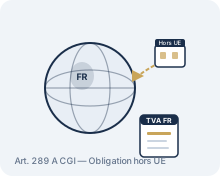
Why non-EU companies are specifically affected
French tax law imposes a clear rule: any company that is not established in the European Union and that carries out VAT-taxable transactions in France must appoint an accredited tax representative. This obligation is set out in Article 289 A of the French General Tax Code (CGI) and allows for very few exceptions.
Unlike EU-established companies, which can register directly for French VAT or use the OSS One-Stop Shop, non-EU companies cannot represent their own French tax interests. The tax representative is therefore their legal agent before the DGFiP: they sign returns on the company's behalf, respond to the administration's requests, and assume joint and several liability.
Which transactions trigger the obligation?
The obligation arises as soon as the foreign company carries out a VAT-liable transaction in France. The most common cases are:
- Sale of goods located in France: goods stored in a French warehouse (including via Amazon FBA or any 3PL), new real estate, auction sales.
- Import followed by resale: goods imported from outside the EU and sold to French customers generate French VAT that must be collected and remitted.
- Services located in France: building works, cultural or sporting events, certain specific B2C services.
- Intra-community acquisitions: purchase of goods from another EU member state destined for France.
- Transactions as a taxable recipient: under the reverse charge mechanism, certain B2B transactions nevertheless require French registration.
Appointment and registration: the concrete steps
The procedure for appointing a tax representative in France follows a clearly defined process. Here are the key steps:
- Step 1 — Choose a DGFiP-accredited representative: the representative must be approved by the French Tax Authority (DGFiP). Without accreditation, the mandate has no legal value.
- Step 2 — Sign the representation mandate: a contract specifies the scope of the engagement, the mutual obligations, and the terms of any bank guarantee.
- Step 3 — Submit the VAT registration file: the representative submits the application to the Foreign Companies Tax Office (SIEE) in Noisy-le-Grand, which is competent for all foreign companies with no establishment in France.
- Step 4 — Obtain the FR VAT number: the administration assigns an intra-community VAT number beginning with FR, enabling the company to invoice with French VAT.
Ongoing obligations managed by the tax representative
Once appointed, the tax representative continuously handles several reporting and compliance tasks:
- Filing VAT returns (monthly or quarterly CA3 depending on the regime)
- Preparing intra-EU goods movement declarations (DEB) or service declarations (DES) where applicable
- Managing VAT credit refunds from the French tax authorities
- Responding to information requests and audit notices from the DGFiP
- Maintaining the register of taxable transactions and retaining supporting documents
- Notifying any changes affecting the situation of the principal company
To identify an accredited tax representative with experience in your sector, consult our list of DGFiP-accredited tax representatives, with a comparison by speciality and type of clientele.