
Who must register for French VAT?
French VAT registration is mandatory for any foreign company that carries out VAT-taxable transactions on French territory. This obligation applies whether the company is European or established outside the European Union, as soon as the following conditions are met.
The main triggering cases are:
- Sale of goods physically located in France at the time of delivery
- Import of goods into France followed by local resale
- Storage of goods in France in a warehouse or via a logistics provider (FBA, 3PL)
- Carrying out building works or services located in France
- Intra-community acquisitions of goods destined for France
Documents required to prepare the file
The VAT registration file must be rigorously prepared. An incomplete file can significantly delay the assignment of the number and block the start of activities in France. The documents generally requested by the SIEE are:
- Foreign M0 form or equivalent form for declaration of activity in France
- Certificate of incorporation or equivalent document from the country of origin, translated into French and apostilled if necessary
- Articles of association in translated form
- Proof of identity of the legal representative of the principal company
- Signed mandate with the accredited tax representative (for non-EU companies)
- Description of planned operations in France (nature of activities, target customers, estimated volume)
- Foreign bank account details for any potential VAT refunds
Depending on the company's situation and country of origin, additional documents may be requested: evidence of transactions in France, contracts with French partners, or even a bank guarantee.
Procedure with the SIEE: concrete steps
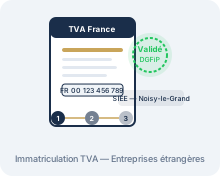
The Foreign Companies Tax Office (SIEE), located in Noisy-le-Grand (Seine-Saint-Denis), is the single point of contact for all foreign companies with no permanent establishment in France. Here are the steps in the registration process:
- Step 1 — Appoint the accredited tax representative (mandatory for non-EU companies): sign the representation mandate, which will be attached to the file.
- Step 2 — Prepare the complete file: gather and translate supporting documents, draft the description of activities.
- Step 3 — Submit to the SIEE: the file can be submitted by registered post or, for certain procedures, electronically via the professional space on impots.gouv.fr opened by the tax representative.
- Step 4 — File review: the SIEE may request additional documents. Prompt contact and documented responses speed up processing.
- Step 5 — Assignment of the FR VAT number: the administration sends written confirmation with the 13-character intra-community VAT number (FR + 11 digits).
After registration: what this entails
Obtaining the French VAT number is not an end in itself: it is the beginning of recurring reporting obligations. The accredited tax representative handles the subsequent operations, but the principal company must regularly provide it with the necessary data.
- Monthly or quarterly CA3 VAT returns: collecting VAT on sales, deducting VAT on purchases, remitting the balance to the DGFiP.
- Intra-EU goods movement declarations (DEB): if the company moves goods between France and other EU countries, a monthly declaration is mandatory above certain thresholds.
- Retention of supporting documents: purchase and sales invoices, customs documents, delivery proof — for 10 years in France.
- Updates in the event of changes: changes to share capital, changes in activity, cessation — the SIEE must be notified through the tax representative.
To carry out these procedures without risk, engage a DGFiP-accredited tax representative specialising in foreign companies. Our comparative list allows you to select the right profile according to your country and sector of activity.