Foreign Holding Company Owning Property in France: Obligations and Tax Representative
Do you hold French real estate through a foreign holding structure? The tax obligations are numerous and the traps costly. Here is what you need to know.
Why hold French real estate through a holding company?
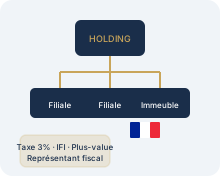
Holding French buildings through a foreign company — a Luxembourg, Dutch or Swiss holding, or more rarely through offshore structures — serves various wealth planning and tax purposes: optimising succession, limiting personal liability, centralised management of several properties in different countries, or advantages under specific tax treaties.
Whatever the rationale, French tax law takes these structures into account and imposes a set of specific obligations on them that can prove more burdensome than direct ownership. Knowing these rules is essential to avoid costly tax surprises.
The French tax authorities monitor foreign structures
Since successive Finance Acts and the EU anti-avoidance directives (ATAD 1 and 2), the scrutiny of foreign structures holding real estate in France has been considerably strengthened. Transparency of beneficial owners has become an inescapable legal requirement.
The 3% levy: the overlooked obligation
Article 990 D of the French General Tax Code institutes an annual levy of 3% on the market value of buildings located in France held directly or indirectly by legal entities (companies, foundations, trusts, funds) whose registered office is outside France.
This levy is due on 1 January of each year. It is designed to discourage anonymous ownership of buildings in France through opaque structures. Exemptions are granted in the following cases:
The entity makes an annual commitment to declare the list of its shareholders, the value of its buildings and their location (form n°2746)
The entity is established in a country that has signed an administrative assistance agreement with France in tax matters
The entity's shares are listed on a regulated market
The market value of the buildings represents less than 50% of the entity's total French assets
Risk of accumulation over several years
If a foreign holding has not declared and paid the 3% levy for several years, the amount due can be considerable, increased by penalties (40% for deliberate non-compliance) and late-payment interest (0.20% per month). The tax authorities can claim taxes due going back 6 years (ordinary time limit) or even 10 years (in cases of fraud).
IFI and corporation tax for foreign holdings
Real estate wealth tax (IFI): foreign entities whose French assets represent more than 50% of their total assets, and whose net French property value exceeds €1,300,000, may be subject to IFI. This tax applies to individual beneficial owners through the transparency of the structures.
Corporation tax (IS): a foreign holding that receives property income in France (rent) or realises a capital gain on a disposal may be subject to French corporation tax if it has a permanent establishment in France, or to withholding tax on property income under applicable tax treaties.
Practical example
A Luxembourg holding company (société anonyme under Luxembourg law) owns a rental building in Paris worth €3,000,000. It receives €120,000 in annual rent. French tax obligations: (1) 3% levy = €90,000/year unless exempted by filing commitment; (2) income tax or corporation tax on rental income depending on the structure; (3) VAT if the lettings are subject to the VAT option; (4) potential IFI for individual shareholders.
Real estate VAT and fiscal representative
A foreign holding may be subject to French VAT in two main situations:
Letting with VAT option: lettings of commercial properties can be opted into VAT (Article 260-2 of the CGI). This option allows recovery of VAT on works and charges but requires charging VAT on rent
Sale of new buildings or off-plan (VEFA): sales of buildings completed less than 5 years ago are subject to real estate VAT at 20%
For holdings established in an EU Member State, appointing an accredited fiscal representative for VAT is not mandatory but may be practical. For non-EU holdings, an accredited fiscal representative is mandatory.
Property disposal: capital gains and accredited representative
On disposing of the French property, the foreign holding is subject to non-resident capital gains tax (Article 244 bis A of the CGI). The rate depends on where the holding is established:
Holding in a treaty country (third country): 26.5% or 36.2% depending on the case
Holding in a non-cooperative state or territory (ETNC): 75%
If the net capital gain exceeds €150,000, an accredited fiscal representative is mandatory. The notary cannot finalise the sale without the representative's certificate confirming payment or guarantee of the tax.
Yes, potentially. For real estate VAT, if the holding carries out taxable transactions (VAT-liable lettings, sales of new buildings), it must register for French VAT. As Luxembourg is in the EU, appointing an accredited fiscal representative is not mandatory for VAT. However, for property disposals with a capital gain above €150,000, an accredited representative is required.
Article 990 D of the French General Tax Code (CGI) imposes an annual levy of 3% on the market value of buildings located in France and held by legal entities (companies, trusts, foundations) whose registered office is abroad. This levy is designed to discourage anonymous ownership of property in France through offshore structures. Exemptions exist for entities that disclose their shareholders or beneficial owners to the tax authority.
Several exemption grounds exist: (1) the holding undertakes to declare its shareholders and the value of its properties annually; (2) the holding's shares are listed on a stock exchange; (3) the holding is established in a country that has signed an administrative assistance agreement with France allowing the exchange of information; (4) the holding owns the buildings through a chain of companies that are all fiscally transparent. A specialist fiscal representative can optimise this situation.
Technically yes, but the obligations are very onerous. The 3% levy applies if the entity is unable to disclose its beneficial owners. Moreover, since the AIFM law and anti-money laundering regulations, French notaries, banks and authorities now systematically request the identity of beneficial owners. Fully opaque structures are increasingly difficult to maintain legally in France.
Yes. A foreign company selling a building in France is subject to non-resident capital gains tax (Article 244 bis A of the CGI) at the rate of 26.5% (for EU/EEA entities) or 36.2% (for third-country entities). If the net gain exceeds €150,000, an accredited fiscal representative is mandatory. Companies established in non-cooperative states and territories (ETNC) are subject to a rate of 75%.
Browse our list of tax representatives accredited by the French Tax Authority (DGFiP). Compare specialities, get a quote and secure your tax obligations in France.