
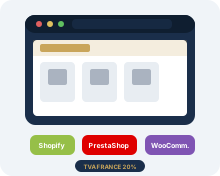
The platform does not change your tax obligations
Whether you use Shopify, PrestaShop, WooCommerce, Magento or any other e-commerce solution, your VAT obligations in France are identical. The platform is a technical tool; it has no tax status. What determines your obligations is exclusively the place of establishment of your business and the place of delivery or use of your goods and services.
A Shopify store managed from the United States that sells clothing to French customers must collect French VAT at 20% and remit it to the French Tax Authority (DGFiP). If the business is established outside the EU, it must also designate an accredited tax representative to manage its declarations in France.
Conditions triggering French VAT
Your online store generates a VAT obligation in France in the following situations:
- B2C sales of physical goods delivered in France — 20% rate on the vast majority of products
- Sales of digital services (B2C) — subscriptions, downloadable software, online courses
- Storage of goods in France — warehouse, French 3PL logistics provider (see our page on storage in France)
- Use of the Amazon FBA platform — if your stock is in an Amazon France warehouse
- B2B sales without valid reverse charge — if your French customer does not provide a valid intra-community VAT number
How to become compliant
The VAT compliance process for a foreign online store selling in France involves several key steps:
1. Designate an accredited tax representative. This is the essential prerequisite for non-EU businesses. Without a representative, it is impossible to register for VAT in France.
2. Obtain a French intra-community VAT number. The tax representative compiles the file and submits it to the French Tax Office (SIE) for non-residents (Paris). The processing time is generally 4 to 8 weeks.
3. Configure your store. Once the VAT number is obtained, it must be entered into your store's tax settings (Shopify Tax, PrestaShop fiscal settings, WooCommerce EU VAT Number…). All sales to France must then include French VAT.
4. File monthly or quarterly declarations. Your tax representative files CA3 returns with the French Tax Authority (DGFiP) and pays the collected VAT.
VAT configuration in your store
Each platform offers its own tools for managing VAT. Here are the essential points to configure once your French VAT number has been obtained:
- Shopify — "Taxes and duties" section: add France as a tax region, enter your VAT number, enable automatic collection at 20%
- PrestaShop — "Tax rules" module: create a French VAT rule at 20% and associate it with products sold in France
- WooCommerce — "Tax" settings: enable taxes, create a standard France rate at 20%, install a VAT number validation extension for B2B customers
Important: technical configuration in your store does not replace your declaratory obligations. Even if VAT is collected automatically, it must be declared and remitted to the French Tax Authority (DGFiP) by your tax representative.
For guidance through this process and to ensure compliance from your very first euro of sales in France, consult our list of accredited tax representatives.